
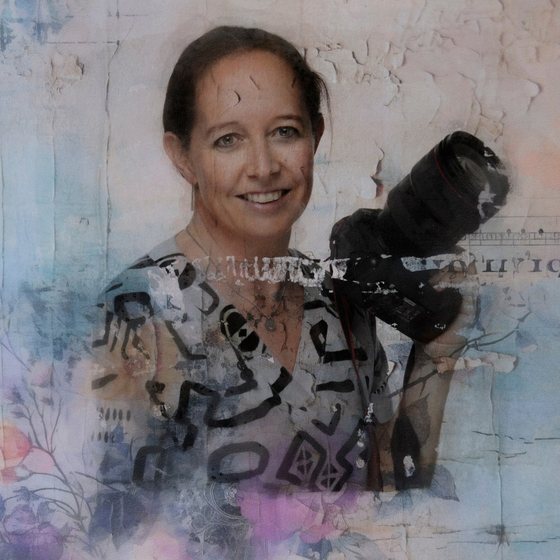
Creative Advisor
Mia Joubert
Mia Joubert's photography is rooted in a lifelong connection to dance and the arts, and the years she spent as a dancer gave her a profound understanding of movement, expression and the relationship between the human body and emotion. This sensibility continues to shape everything she makes. She works across portraiture, landscape, wildlife and conceptual photography. Still, she is most deeply drawn to fine art, drawn to images that transcend documentation and invite the viewer to pause, reflect and find their own meaning within the frame. Her practice embraces experimental and mixed media approaches, moving freely between compositing, texture work, multiple exposures, body painting, transfers, clay and paint, allowing each project to evolve in its own way and on its own terms. Nature plays an equally important role, whether she is photographing dancers beneath jacaranda trees, working in forests or capturing the dramatic landscapes of Iceland and Namibia, always searching for the point where light, place and human presence come together into something dreamlike and quietly alive.
Showcase
Seven pieces, and what is behind them
Click on the artwork to see it larger, and read Mia’s own description of each piece.
Work 01
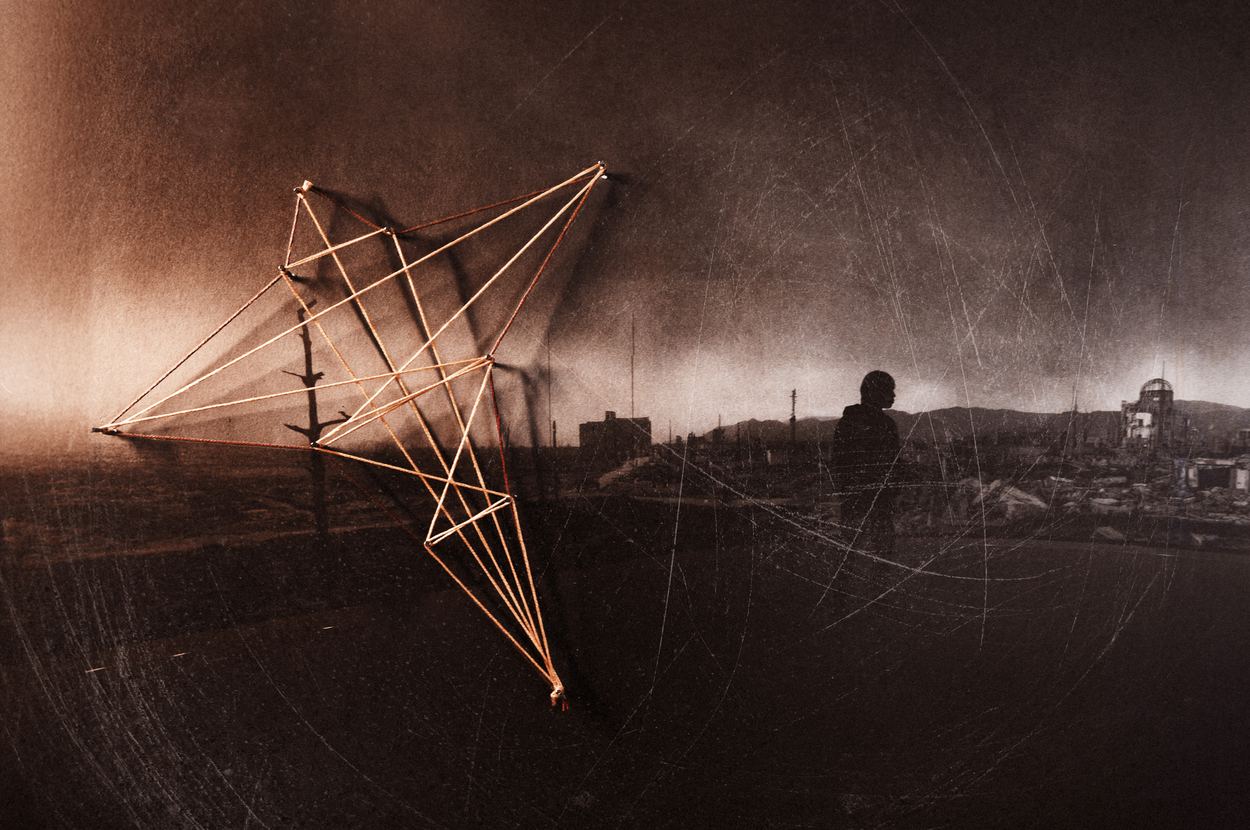
1000 Cranes
1000 Cranes Inspired by the story of Sadako Sasaki and the Japanese legend that promises a wish to anyone who folds one thousand paper cranes, this work explores themes of hope, memory, and healing in the aftermath of tragedy. The image combines a historical photograph of Hiroshima with a physically constructed thread drawing, created using pins and string directly on a printed image before being digitally refined. The geometric form references the crane, not as a complete object, but as a fragmented reconstruction, suggesting both the fragility of life and the resilience of the human spirit. The intersecting threads symbolise connections across generations, linking individual stories of loss with humanity’s enduring capacity for hope. The solitary figure stands as a witness between past and present, while the distressed surface reflects the scars left behind by history. Rather than depicting destruction, 1000 Cranes is a meditation on remembrance, healing, and the quiet power of hope to survive even the darkest moments. Technique Description Technique: Mixed Media Thread Construction A historical image was printed and used as the foundation for a physical thread installation. Pins were placed directly onto the print and connected using fine thread to create a geometric interpretation of an origami crane. The completed construction was then re-photographed and digitally refined, with additional texture and tonal adjustments incorporated to strengthen the narrative and emotional atmosphere.
Work 02
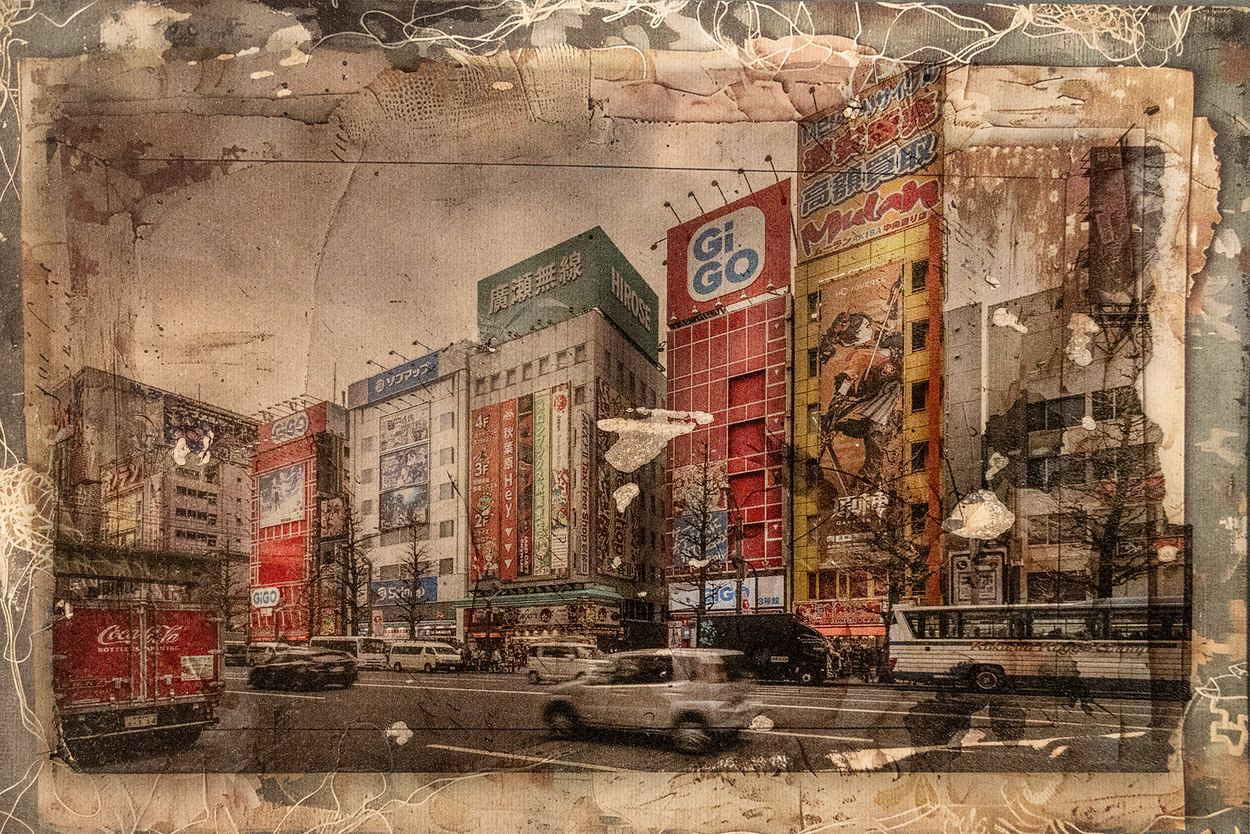
Fragments of Akihabara
Fragments of Akihabara Tokyo is often portrayed through bright neon lights, crowded streets, and endless movement. Yet our memories of a place rarely remain as sharp as the original experience. They become layered, fragmented, and textured by time. This work was created from a photograph taken in Tokyo’s famous anime district and transferred onto textured paper using the TransferEze process. During the transfer, portions of the image were intentionally lost, altered, or transformed. Additional textures became part of the final piece, creating a dialogue between the original photograph and the physical surface that now carries it. The resulting image exists somewhere between photography, printmaking, and memory. The worn textures and distressed surfaces reflect the way experiences gradually evolve after they have passed. Rather than documenting a location, the work explores how places are remembered, through fragments, impressions, and emotions rather than perfect detail. The vibrant commercial energy of the district remains visible beneath the layers, while the transfer process softens the image into something more personal and nostalgic, transforming a busy urban scene into a visual memory. Technique Description Technique: Photographic Transfer Mixed Media A photographic image of Tokyo’s anime district was transferred onto textured paper using the TransferEze transfer process. The transfer naturally introduced imperfections, losses, and surface variations that became part of the artwork. Additional textures and layered elements were incorporated during the creative process, allowing the photograph to evolve into a mixed-media piece that combines photographic capture with physical surface manipulation.
Work 03
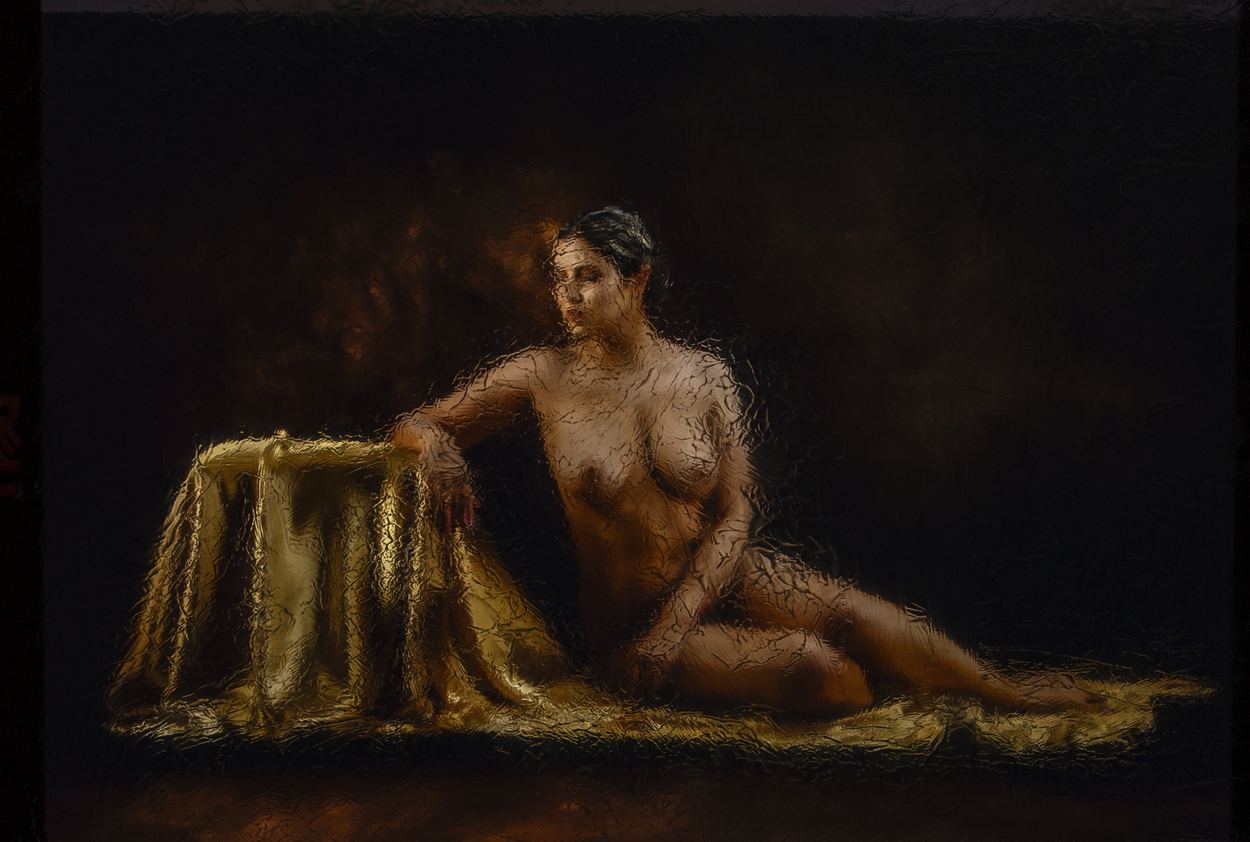
Fragments of light
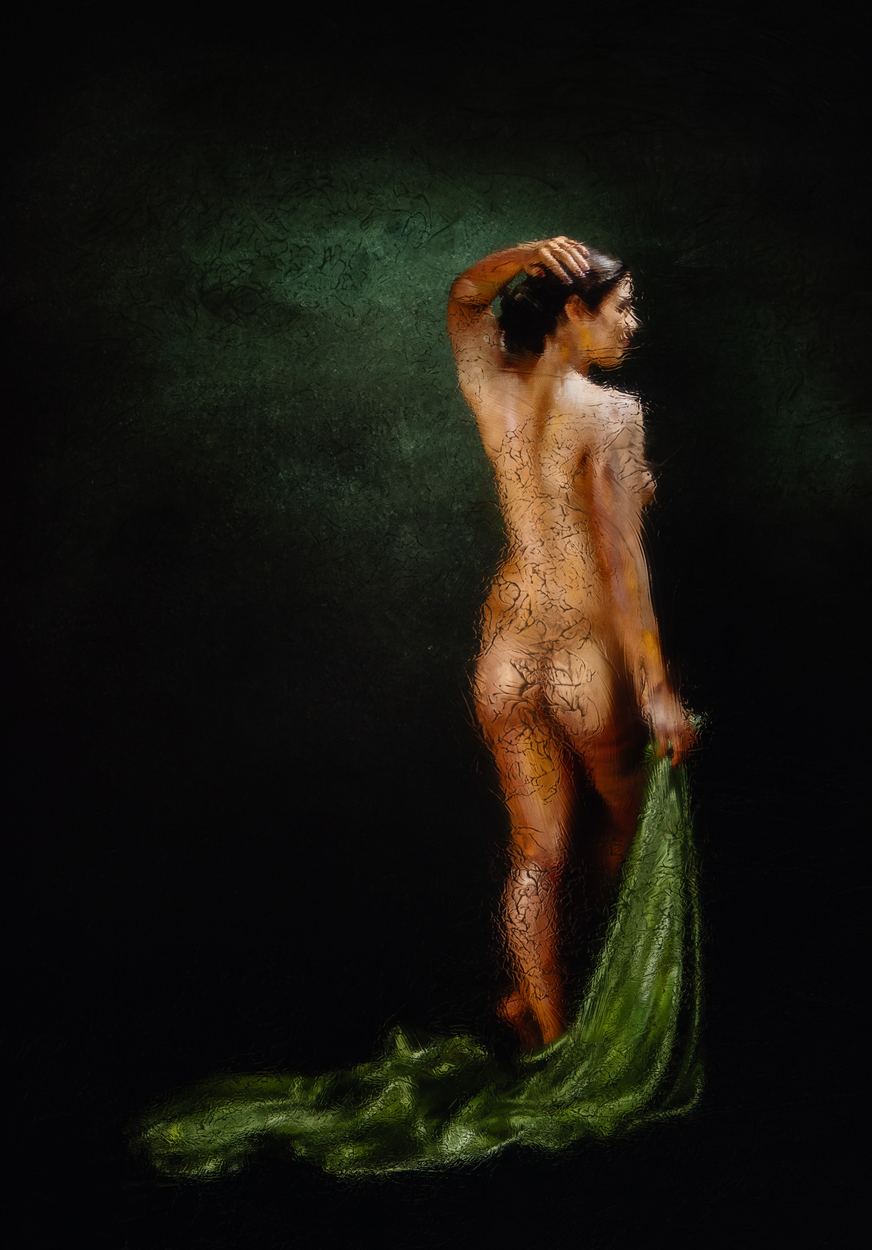
Fragments of light In Fragments of Light, the human form becomes a living sculpture, part flesh, part canvas, part illusion. These images are born from a process that intentionally blurs the boundary between photography and painting, inviting the viewer into a dreamlike world where texture replaces detail, and feeling outweighs clarity. The model’s body was first transformed with layers of body paint, adding dimension and tactile nuance. Rather than projecting directly onto her, I created textured visuals on a computer screen, fragmented, abstract patterns designed to evoke the feel of aged oil paint. A sheet of glass, coated with Vaseline, was then held over the screen. Through this handmade filter, the camera captured a final image: a synthesis of the painted form and digital projection, refracted through a lens of distortion.
Work 04
Echoes of the canvas
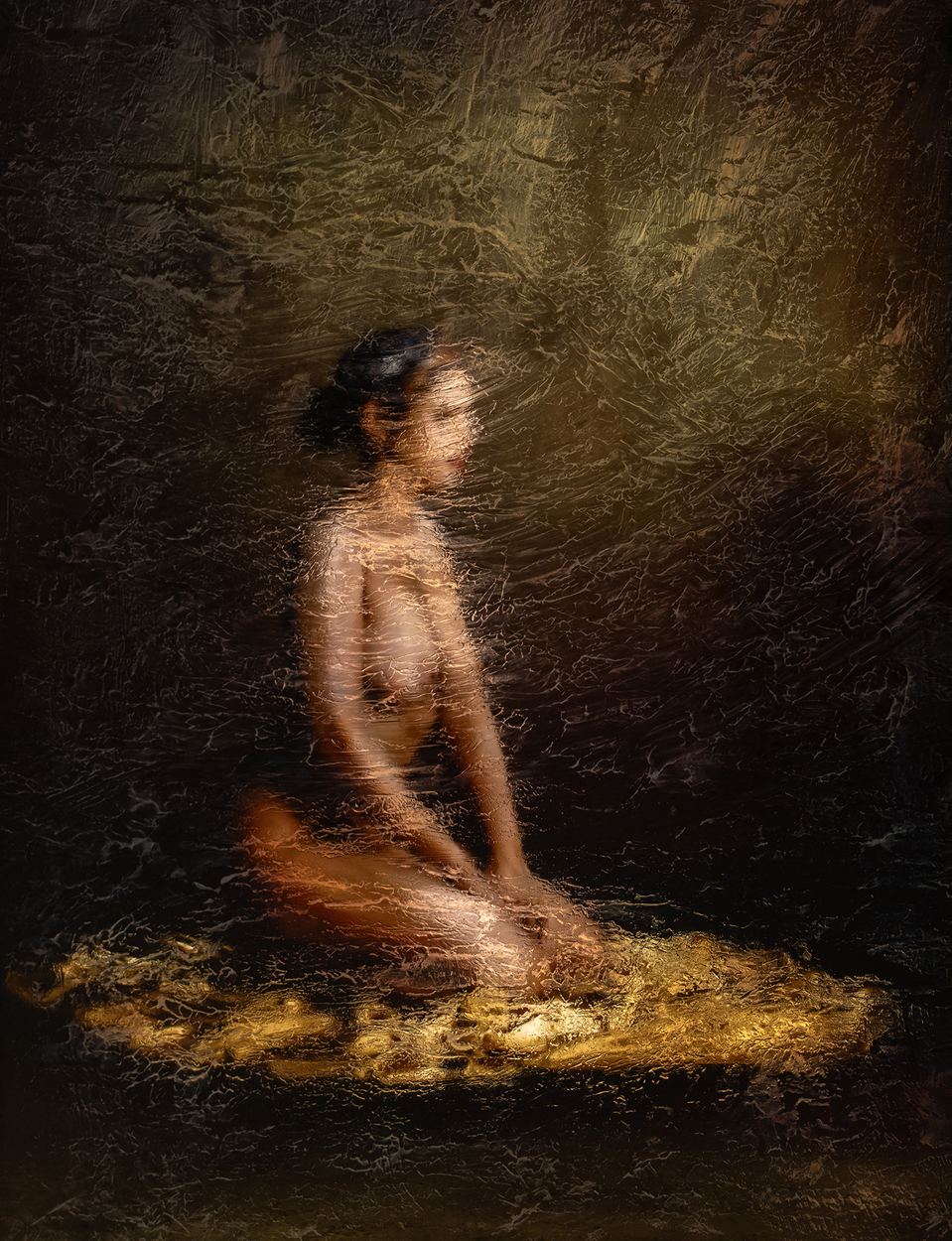
Echoes of the Canvas In Echoes of the Canvas, the human form becomes both subject and medium, a living canvas suspended between photography and painting. The work explores themes of fragility, transformation, and the fleeting nature of beauty, inviting the viewer into a space where reality dissolves into impression. The figure appears to emerge from layers of texture and shadow, as though she has stepped from an aged painting or is slowly returning to it. Surface cracks and painterly textures become part of the narrative, suggesting the passage of time and the marks left behind by memory and experience. Rather than presenting the body as a precise representation, the image seeks to evoke emotion through ambiguity, allowing the viewer to complete the story for themselves. Created through a combination of body painting, digital imagery, and handmade optical effects, the work intentionally blurs the boundaries between photographic capture and painterly interpretation. Textured visuals were first created digitally and displayed on a screen. A sheet of glass coated with Vaseline was then placed between the camera and the projected imagery, introducing distortion, softness, and unpredictability into the final photograph. The resulting image is neither entirely photograph nor painting, but a synthesis of both. Through this process, Echoes of the Canvas becomes a meditation on impermanence, an exploration of how identity, memory, and beauty are continually shaped, altered, and softened by time.
Work 05
Fragments of grace
Fragments of Grace Grace is often thought of as something complete, a perfect movement, a flawless form, a fleeting moment of beauty. Yet memory rarely preserves perfection. What remains are fragments: impressions, emotions, and traces of moments that continue to resonate long after they have passed. In Fragments of Grace, the figure appears suspended between presence and disappearance. Layers of texture veil and reveal the body simultaneously, transforming the subject into something that exists between reality and memory. The work explores the delicate relationship between beauty and impermanence, inviting the viewer to look beyond physical form and into the emotional essence that remains. The fractured surface recalls aged paintings, weathered walls, and forgotten stories, suggesting that time does not diminish beauty but rather reshapes it. The figure becomes a vessel for memory itself, softened, altered, and enriched through the passage of time. Rather than documenting a person, the image seeks to capture a feeling: the lingering echo of grace after the moment has passed. Technique Description Technique: Mixed Media Photographic Impressionism This artwork was created through a combination of body painting, photography, textured overlays, and handmade optical distortion. The model was photographed through a textured glass surface coated with Vaseline, allowing light and form to dissolve into painterly abstraction. Additional surface textures were incorporated to create the appearance of an aged, weathered painting, blurring the distinction between photographic capture and fine art painting. The resulting image emphasises atmosphere and emotion over detail, allowing texture, light, and form to become equal participants in the visual narrative.
Work 06
Crossing paths
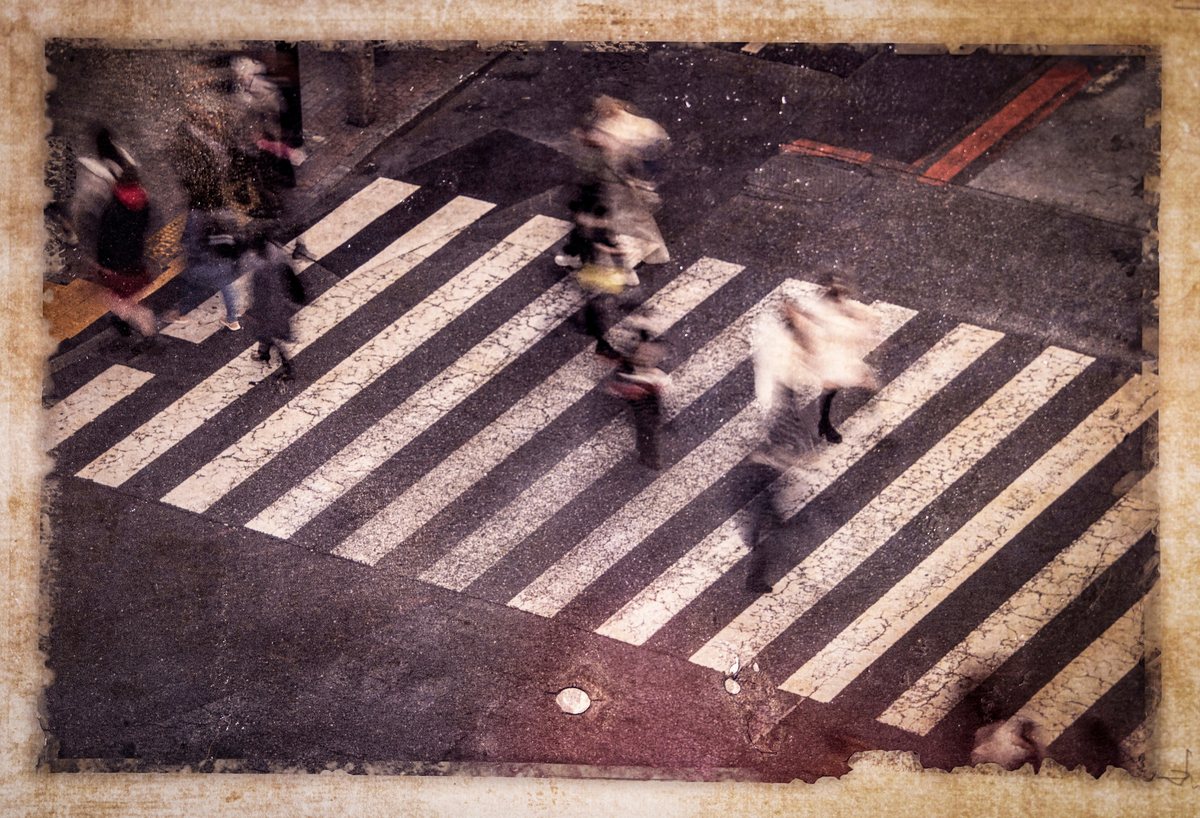
Crossing Paths In the heart of one of the world’s busiest cities, thousands of lives intersect every day. Strangers share a moment of space and time before continuing on separate journeys, often without ever noticing one another. This image captures a fleeting instant within Tokyo’s famous crossing, where movement becomes a visual language of modern life. The blurred figures are intentionally stripped of individual identity, transforming them into symbols of the countless stories, ambitions, routines, and dreams that pass through the city each day. Created through a photographic transfer process and layered with distressed textures, the work explores the contrast between permanence and transience. The crossing itself remains fixed and structured, while the people dissolve into motion, reflecting the temporary nature of human encounters and the passage of time. The aged surface suggests a memory rather than a document, a recollection of movement, energy, and connection that remains long after the individuals themselves have disappeared from view. ⸻ Technique Description Technique: Photographic Transfer Mixed Media A long-exposure photograph of a busy Tokyo pedestrian crossing was transferred onto textured paper using the TransferEze process. The transfer introduced natural imperfections, surface variations, and areas of loss that became integral to the final artwork. Additional textures were incorporated to create an aged, weathered appearance, transforming a contemporary urban scene into a layered exploration of memory, movement, and time.
Work 07
Cheetah in the dust
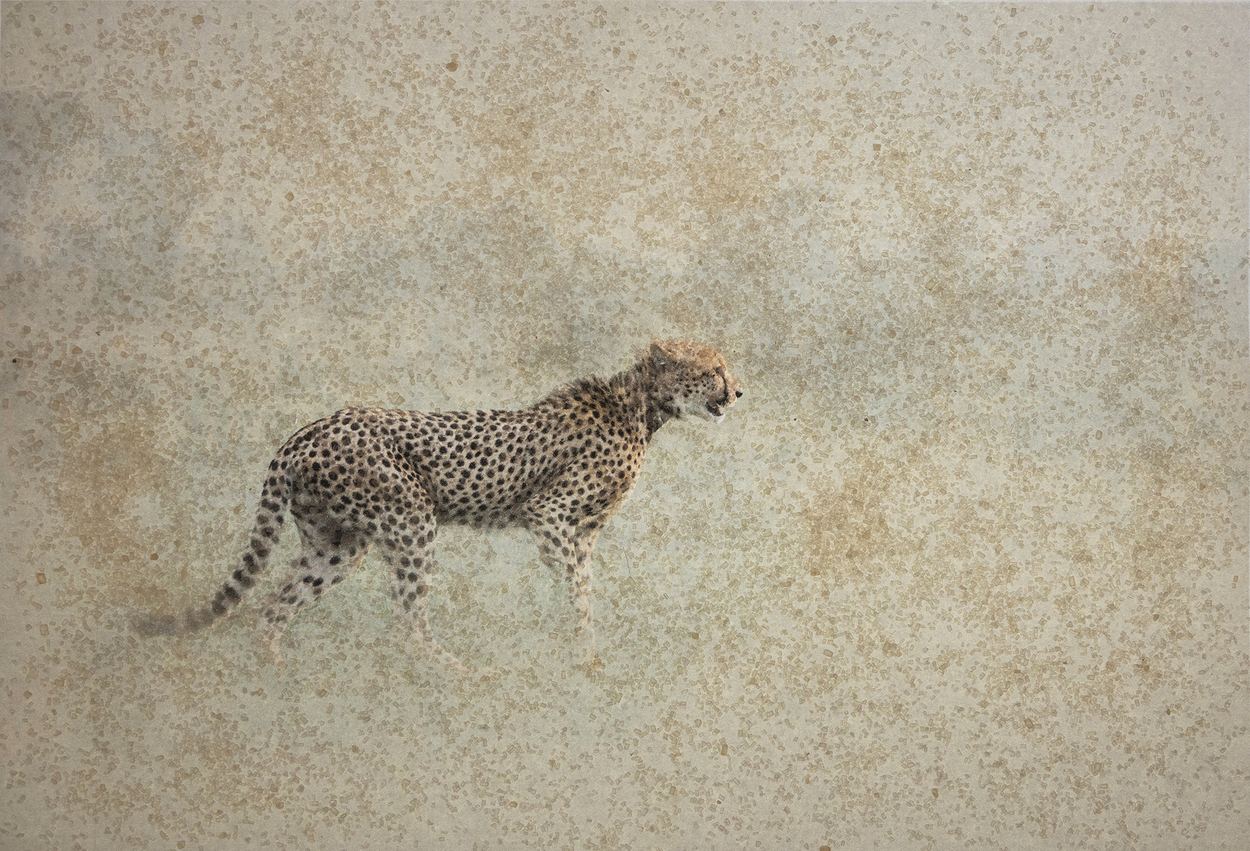
Cheetah in the dust The cheetah is often celebrated for its speed, power, and pursuit of prey. Yet moments of stillness reveal another side of this remarkable animal, a quiet presence woven into the landscape itself. In this work, the cheetah emerges from a field of texture that mirrors its own markings, blurring the boundary between animal and environment. The vast negative space emphasises both its solitude and its connection to the land, allowing the viewer to experience the subject not as a predator in motion, but as a fleeting presence within a much larger natural world. The textured surface softens the distinction between reality and memory, transforming the image into something that feels less like observation and more like recollection. The animal appears almost suspended between appearance and disappearance, reminding us of the fragile relationship between wildlife and the landscapes they inhabit. Rather than celebrating speed or action, the work invites contemplation of stillness, presence, and belonging. ⸻ Technique Description Technique: Textured Fine Art Wildlife Photography This artwork combines wildlife photography with carefully layered textures designed to create a painterly and atmospheric interpretation of the subject. Surface textures were incorporated to echo the natural patterns of the cheetah’s coat, allowing the animal to visually merge with its surroundings. The resulting image moves beyond documentary wildlife photography, emphasising mood, memory, and emotional connection to the natural world.
In her own words
How Mia got here
Photography, for me, is far more than the act of creating an image. It is a way of exploring emotion, movement, beauty, and the stories that exist beneath the surface. My work is rooted in a lifelong connection to dance and the arts. Having spent many years as a dancer, I developed a deep appreciation for the power of movement, expression, and the extraordinary relationship between the human body and emotion. Today, photography allows me to continue that artistic journey through a different medium.
While I work across several genres, including portraiture, landscape, wildlife, and conceptual photography, I am most deeply drawn to fine art photography. I am fascinated by the ability of a photograph to transcend simple documentation and become something interpretive, emotional, and timeless. Rather than recording what is in front of the camera, I strive to create images that invite the viewer to pause, reflect, and discover their own meaning within the work.
Dance remains at the heart of much of my creative vision. I am captivated by the strength, vulnerability, elegance, and discipline of dancers. Through my images, I seek to capture not only movement itself, but the emotion behind the movement, the fleeting moments that often pass unnoticed. Whether working in a studio environment with carefully controlled lighting or creating images in natural landscapes, I am constantly searching for the balance between technical precision and artistic expression.
I am particularly drawn to experimental and mixed-media approaches within fine art photography. I enjoy exploring techniques that push beyond traditional photographic boundaries, including compositing, texture work, multiple exposures, motion effects, body painting, transfers, and other creative processes that transform a photograph into a more layered artistic experience. Some projects involve physical elements such as clay, paint, or textured surfaces, while others rely on digital artistry to create visual narratives that would otherwise be impossible. I find great joy in blending photography with other artistic disciplines, allowing each project to evolve in its own unique way.
Nature also plays an important role in my work. Whether photographing dancers beneath blooming jacaranda trees, creating conceptual portraits in forests, or capturing the dramatic landscapes of places such as Iceland and Namibia, I am inspired by the relationship between people and their environment. I am fascinated by how light, weather, texture, and location can influence mood and transform a scene into something almost dreamlike.
What I love most about fine art photography is the freedom it offers. There are no rules about what an image should be. Fine art allows me to combine imagination, emotion, and technical craft to create work that feels personal and meaningful. Each image begins with an idea, a feeling, or sometimes simply a question. The creative process becomes a journey of discovery, often leading somewhere unexpected.
At its core, my work is about connection, connection to movement, to emotion, to nature, and to the stories we carry within ourselves. I hope my images encourage viewers to look beyond the obvious, to feel something, and perhaps to see a little of their own story reflected within the frame.
The path she took
She finished the Masterclass
Mia completed every workshop in the programme. It begins with Getting Started in Art Photography, which is where all of this starts.
Look at Getting StartedThe others
Eighteen more artists
Every creative advisor came the same way, and each one has a page of their own with the work they make now.
See all the creative advisorsMia’s creative journey began with just one course
Every artist on these pages started at the same place, unsure whether any of it would come to anything. Getting Started in Art Photography is where that begins.
Begin your journey in fine art photography